
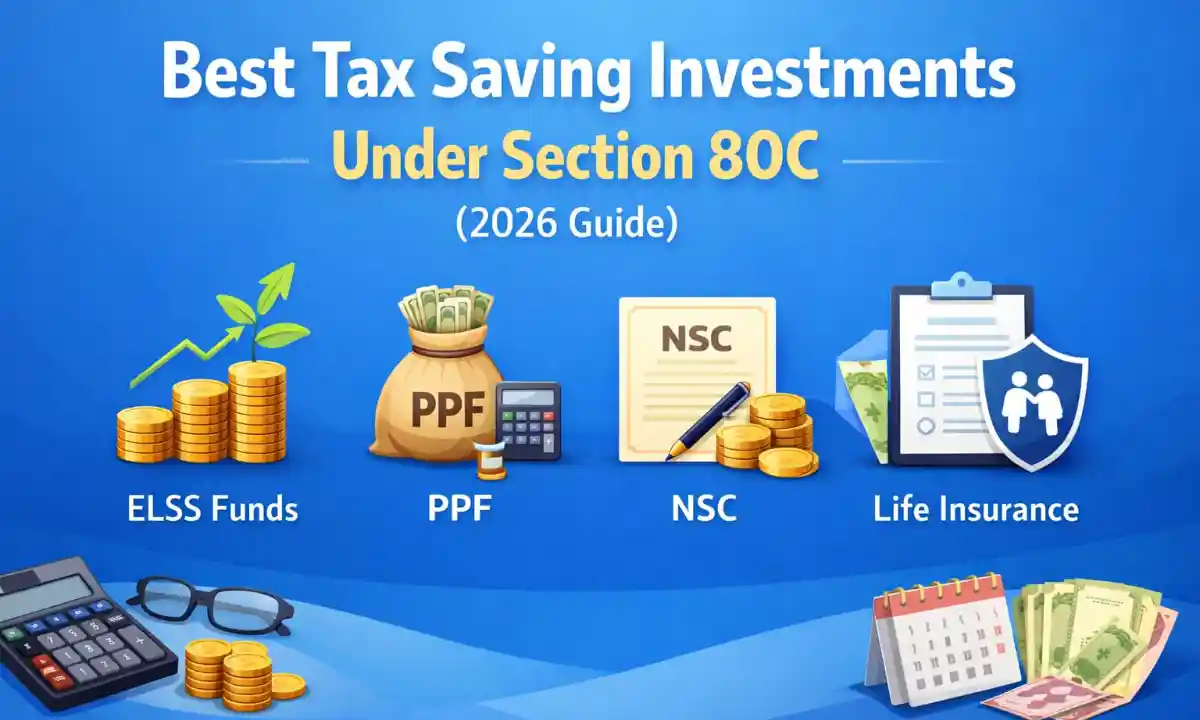
If you’re looking to reduce your tax liability legally, Section 80C of the Income Tax Act is your biggest opportunity. It allows deductions of up to ₹1.5 lakh per financial year — but choosing the right investment makes a big difference.
Here’s a clear breakdown of the best tax-saving options under Section 80C in 2026, based on returns, lock-in period, and risk level.
Public Provident Fund (PPF)
The Public Provident Fund remains one of the safest 80C options.
Key features:
- Government-backed scheme
- 15-year lock-in
- Interest compounded annually
- Completely tax-free maturity (EEE benefit)
Best for: Conservative investors planning long-term wealth creation.
ELSS (Equity Linked Saving Scheme)
ELSS mutual funds offer the shortest lock-in among 80C options.
Highlights:
- 3-year lock-in
- Market-linked returns
- Potential for higher long-term growth
ELSS is ideal if you can handle market ups and downs and want better returns compared to traditional savings products.
Best for: Young investors with higher risk appetite.
5-Year Tax Saving Fixed Deposit
Most banks offer tax-saving FDs with a 5-year lock-in.
Benefits:
- Guaranteed returns
- Low risk
- Simple to open
Interest earned is taxable, but the invested amount qualifies for 80C deduction.
Best for: Investors who prefer predictable returns.
Home Loan Principal Repayment
If you have a home loan, the principal repayment portion qualifies under 80C.
Why it’s useful:
- Dual benefit: tax saving + property ownership
- No separate lock-in beyond property holding rules
This is one of the most common ways salaried individuals claim 80C deductions.
Life Insurance Premium
Premiums paid for life insurance policies qualify under Section 80C.
Important:
- Choose protection-focused plans (term insurance)
- Avoid mixing insurance and investment unless necessary
Insurance should be primarily for financial security, not just tax saving.
Sukanya Samriddhi Yojana (SSY)
The Sukanya Samriddhi Yojana is designed for the girl child.
Benefits:
- High government-backed interest
- Tax-free maturity
- Long-term savings for education/marriage
Ideal for parents planning future expenses.
Employees’ Provident Fund (EPF)
If you’re salaried, EPF contributions automatically qualify under 80C.
The Employees’ Provident Fund Organisation manages this scheme.
Why it’s powerful:
- Employer contribution adds extra benefit
- Stable interest rate
- Retirement-focused savings
Quick Comparison
| Investment | Lock-in | Risk | Return Potential |
|---|---|---|---|
| PPF | 15 years | Very Low | Moderate |
| ELSS | 3 years | High | High |
| Tax FD | 5 years | Low | Moderate |
| EPF | Till retirement | Low | Stable |
| SSY | Long-term | Very Low | Attractive |
How To Choose the Right 80C Investment
Ask yourself:
- Do I need liquidity?
- Can I handle market risk?
- Am I investing for retirement or short-term saving?
For balanced planning:
- Combine ELSS (growth) + PPF/EPF (stability)
- Use insurance only for protection
Final Takeaway
Section 80C is not just about saving tax — it’s about building long-term wealth smartly. The right mix of investments can reduce your tax burden while helping you achieve financial goals.
Before investing, review your overall financial plan and choose options that match your risk level and time horizon.