
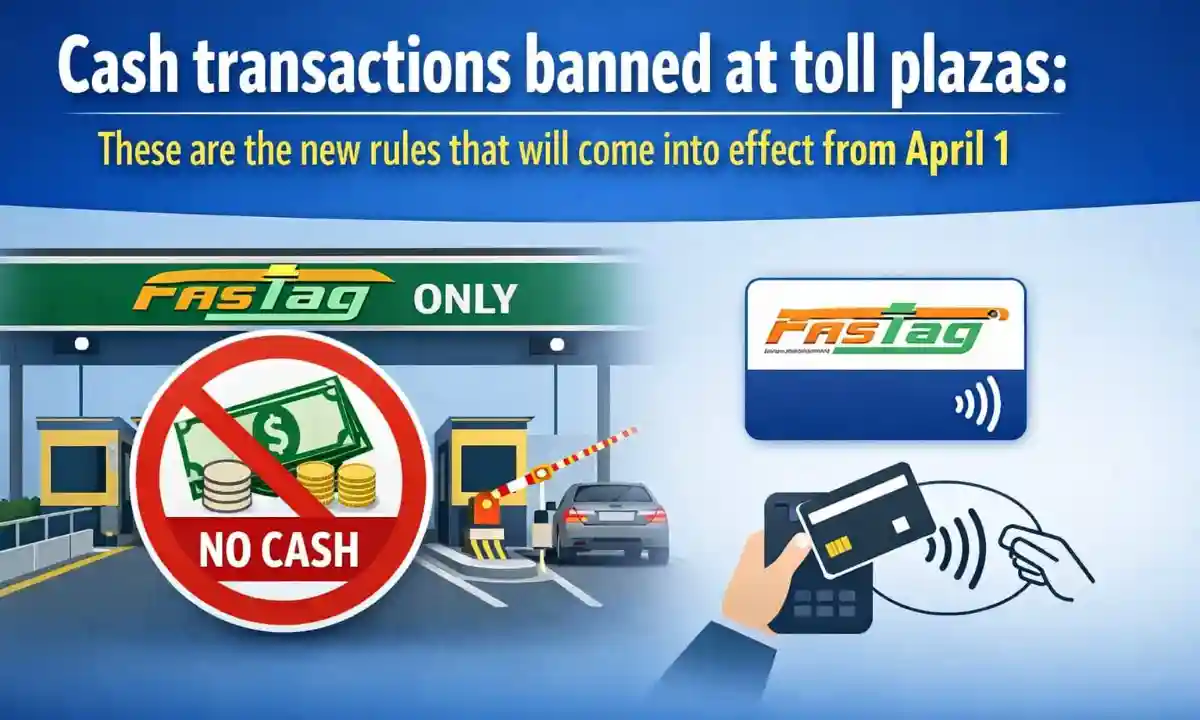
The digital revolution is growing rapidly in India. From small shops to big malls, UPI payments have become a must today. In this regard, the National Highways Authority of India (NHAI) has taken a significant decision. It has decided to completely stop cash payments at toll plazas across the country and make digital payments mandatory.
What is the new rule?
With effect from April 1, 2026, toll charges on national highways will have to be paid only through FASTag or UPI. The NHAI will completely ban the cash payment system that was prevalent till now. The authority has warned that if motorists try to pay in cash beyond this rule, they may have to pay a hefty fine.
What are the objectives of cashless service?
The main objective of this project is to reduce vehicle congestion at toll booths and save time for commuters.
- Time Saving: During cash payments, there was a problem of loose change and a lot of time was spent getting a receipt. This will be avoided with digital payments.
- Fuel savings: Vehicles will not have to wait for long periods at toll booths, which will reduce fuel consumption.
- Transparency: There will be transparency in the transaction as every payment will be recorded digitally.
- Uninterrupted travel: This system will help vehicles move smoothly on highways.
How much is the fine?
As per the current rules, if you enter the toll plaza without an active FASTag and pay cash, you will have to pay 2 times the normal fee . However, if you pay through UPI, you will have to pay 1.25 times the normal fee . However, this penalty is likely to increase further after April 1.
Applicable at more than 1,150 toll plazas
This new rule will be implemented at over 1,150 toll plazas on highways and expressways across the country. Already, 98% of vehicles are using FASTag, and the government’s target is to bring the remaining 2% of vehicles under digital coverage.
Important instructions for motorists:
- Check today if your vehicle’s FASTag is active.
- Always ensure that there is a minimum balance in the FASTag account.
- Make sure UPI apps are working properly on your mobile for emergency situations.
Future Technology: Satellite-Based Toll (GNSS)
In the coming days, the FASTag system will also become history. It will be replaced by Global Navigation Satellite System (GNSS) technology.
- Vehicles are equipped with a special device called an On-Board Unit (OBU).
- It is directly connected to the satellite, and the cost is deducted only for the distance you travel on the highway.
- This eliminates the need to park near toll plazas.
Our advice
Before setting off on a highway journey, make sure you have at least Rs 200 in your FASTag wallet. There may be network issues near the toll plaza, so it is better to recharge your FASTag as a precaution. Be prepared to pay via UPI if the scanner doesn’t work.
Frequently Asked Questions (FAQs)
Question 1: What happens if my vehicle does not have a FASTag?
Answer: If you do not have a FASTag after April 1, you will have to pay a hefty fine to cross the toll. Get a FASTag immediately through any bank or online.
Question 2: Will extra money be deducted if I pay through UPI?
Answer: Yes, as per the current rules, if you pay through UPI, you will have to pay 1.25 times the normal fee. Using FASTag is the most beneficial.