
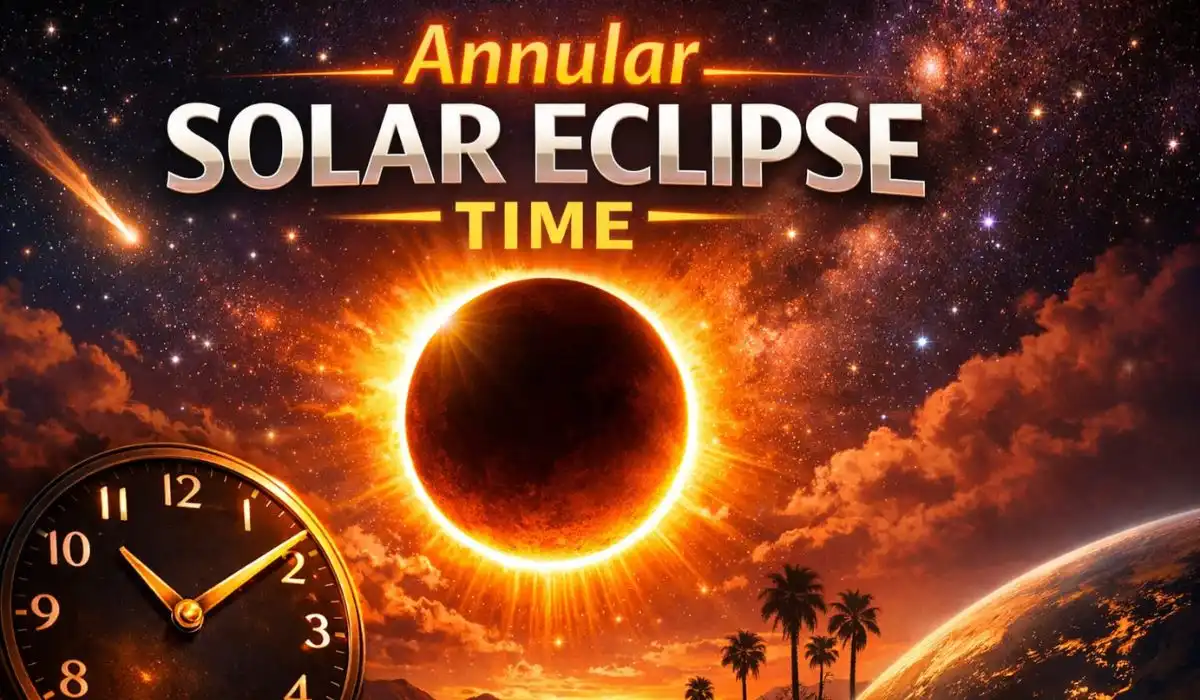
The Rare “Ring of Fire” Solar Eclipse On February 17, 2026, the world will witness a breathtaking astronomical event — an annular solar eclipse that turns the Sun into a glowing “ring of fire.” Unlike a total eclipse, the Moon will pass in front of the Sun while appearing slightly smaller, leaving a brilliant ring of sunlight visible around its edges. This rare alignment captures global attention for both its beauty and its scientific value.
Although only select regions of the planet will see this eclipse directly, it stands out as one of the most fascinating sky events of 2026. Astronomers, photographers, and space enthusiasts are already preparing to observe, study, and share this moment with the world through live coverage and research observations.
What Is an Annular Solar Eclipse?
An annular eclipse occurs under very specific orbital conditions between Earth, the Moon, and the Sun:
- Happens when the Moon is near apogee (farthest from Earth), so it looks smaller in the sky
- The Moon cannot fully cover the Sun, creating a bright circular ring of sunlight
- This creates the famous “ring of fire” visual effect
- Demonstrates how orbital distances directly affect the type of eclipse we see
This type of eclipse is less common than partial eclipses and offers unique opportunities for scientific study and skywatching.

Timing and Duration: Exact Eclipse Schedule
Knowing the precise schedule helps enthusiasts follow the event accurately:
- Date: February 17, 2026
- Partial eclipse begins: Around 09:56 UTC
- Maximum annularity: Around 12:12 UTC (peak ring of fire moment)
- Partial eclipse ends: Around 14:27 UTC
The bright annular “ring” phase will last just over 2 minutes along the central path, while the overall eclipse spans several hours from start to finish.
Where Will It Be Visible?
The visibility path of this eclipse is unusual and limited to specific regions:
- The full annular “ring of fire” will be visible only from Antarctica
- Some research stations in Antarctica may observe the complete annular phase
- Southern parts of Africa and South America will witness partial phases
- India and most of Asia will not see this eclipse, as it occurs below the horizon
Because the central path crosses remote icy landscapes, very few people will see the full spectacle directly.

Safety Tips for Viewing
Solar eclipses must always be viewed with proper precautions:
- Use certified solar eclipse glasses meeting ISO safety standards
- Never look directly at the Sun without protective filters
- Cameras, telescopes, and binoculars must have solar filters attached
- Watching through official live streams is a safe and effective alternative
These precautions protect your eyes while allowing you to enjoy the event safely.
Scientific Importance and Global Interest
This eclipse is not just visually stunning but scientifically valuable:
- Helps study solar limb darkening and atmospheric light effects
- Provides data on orbital mechanics and eclipse geometry
- Assists in calibrating solar observation instruments
- Encourages student and public engagement with real astronomy events
Researchers across the globe track annular eclipses to deepen understanding of the Sun–Earth–Moon relationship.

How to Watch the Eclipse Remotely
If you’re far from the visibility zone, you can still experience the eclipse:
- Space agencies and observatories will host live streams
- Educational platforms may conduct expert webinars and commentary
- Planetariums might organize special viewing sessions
- Social platforms will share images, videos, and real-time updates
Technology ensures this remote eclipse can still be witnessed worldwide.
Conclusion: A Celestial Moment to Remember
The February 17, 2026 annular solar eclipse is a rare cosmic display that highlights the beautiful precision of our solar system. Though visible fully only from Antarctica and partially from a few southern regions, its impact will be felt globally through science coverage and live broadcasts.
Whether you watch it through a telescope in the polar cold or on a screen at home, the glowing “ring of fire” will remind us of the extraordinary celestial choreography happening above us every day.