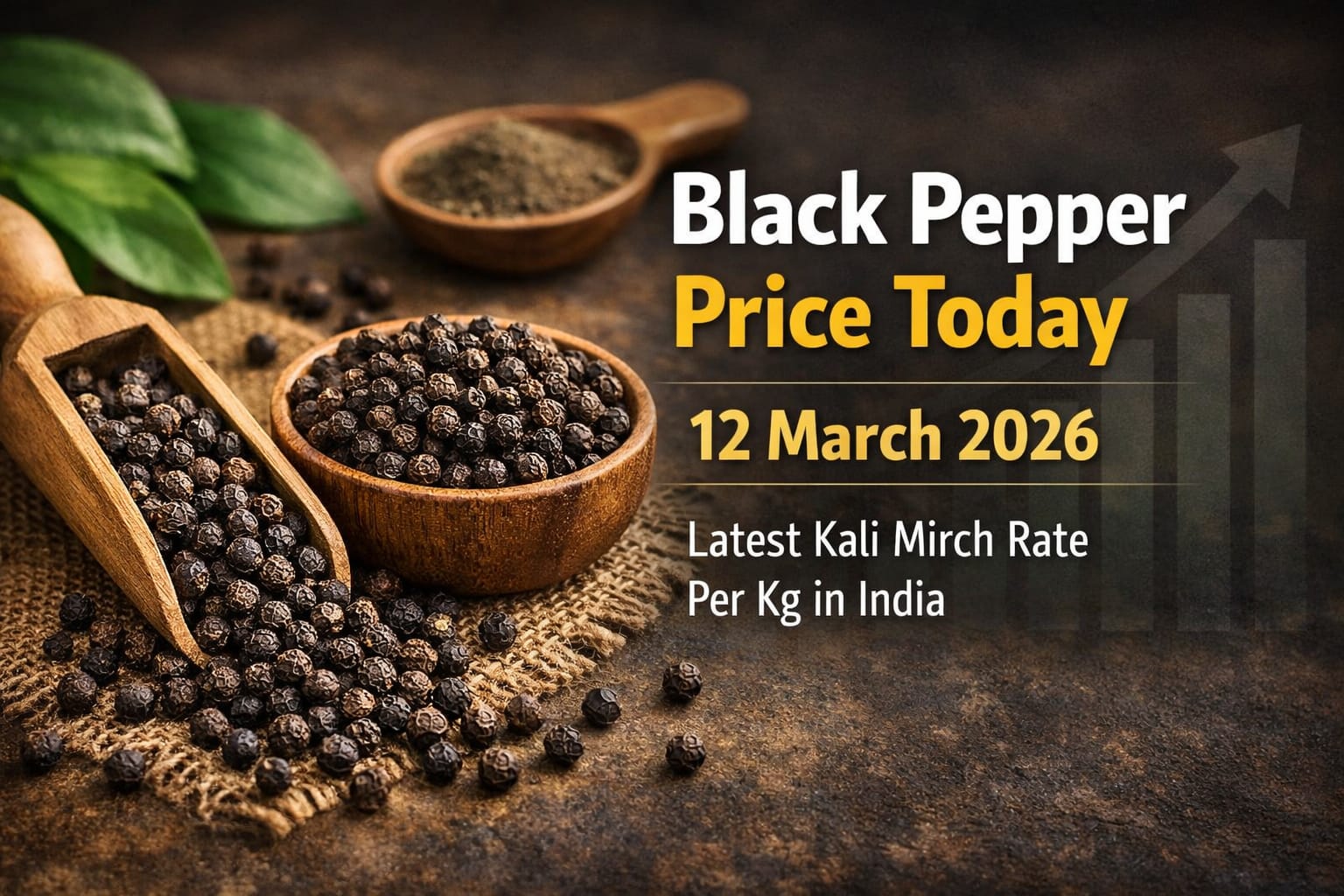
Welcome to your daily spices market update! If you are tracking the “King of Spices,” today brings some interesting movements. Whether you are a trader, farmer, or a curious consumer, staying informed about the latest Kali Mirch rates is essential for making the right financial decisions in today’s fluctuating economy.
Current Market Snapshot: 12 March 2026
The black pepper market in India is showing a robust trend today. Prices are holding firm as the industry reacts to a combination of seasonal supply constraints and steady domestic consumption. Currently, the average price across major Indian hubs fluctuates between ₹650 and ₹720 per kg.
State-Wise Price Comparison
To help you understand the regional variations, we have compiled the latest data from the primary producing states. Kerala continues to command a premium due to the high quality of its garbled varieties.
| State | Variety | Price Range (per kg) | Average Price |
| Kerala | Garbled (Premium) | ₹750 – ₹845 | ₹800 |
| Kerala | Ungarbled | ₹680 – ₹710 | ₹695 |
| Karnataka | Malabar / Other | ₹600 – ₹715 | ₹660 |
| Delhi | Unpolished | ₹740 – ₹760 | ₹755 |
| Maharashtra | Mixed / Other | ₹650 – ₹850 | ₹725 |
Deep Dive: Major Mandi Rates (Spot Prices)
The “Mandi” or wholesale market is where the real price action happens. For March 12, 2026, specific trading hubs in South India are reporting high activity. Export-quality pepper is particularly sought after, leading to localized price spikes.
| Market Hub | Location | Variety | Current Rate (per kg) |
| Kochi | Kerala | Garbled | ₹844 |
| Kochi | Kerala | Ungarbled | ₹821 |
| Chikmagalur | Karnataka | Malabar Grade | ₹710 |
| Sakleshpur | Karnataka | Ungarbled | ₹705 |
| Wayanad | Kerala | Ungarbled | ₹703 |
Factors Influencing Prices in 2026
Understanding why prices move is key to E-E-A-T (Experience, Expertise, Authoritativeness, and Trustworthiness) in market reporting. Several factors are currently squeezing the supply chain:
- Lower Production Estimates: For the 2025-26 season, production is estimated at only 55,000 – 58,000 tonnes. This is a significant drop caused by erratic weather patterns in the Western Ghats, which has limited the harvest.
- Robust Domestic Demand: Even with higher prices, Indian households and the food processing industry maintain a high level of consumption, keeping a floor under the market price.
- The “Quality” Premium: Indian pepper, specifically the Malabar variety, contains higher piperine levels compared to imports from Vietnam or Indonesia. This ensures that Indian farmers receive a better price on the global stage.
Retail vs. Wholesale: What You Pay
It is important to note the difference between the rates mentioned above and what you see at your local store. Wholesale rates are for bulk transactions. When pepper reaches the retail shelf, costs like cleaning, packaging, branding, and transportation are added.
| Purchase Type | Estimated Price Range (per kg) |
| Wholesale (Mandi) | ₹650 – ₹840 |
| Retail (Grocery Store) | ₹850 – ₹980 |
| Premium Branded/Organic | ₹1,100+ |
Expert Market Outlook
Market analysts suggest that the price of black pepper is unlikely to see a major correction (drop) in the short term. Because the harvest is lower this year, stock levels are tight. If export demand from Europe and the Middle East increases during the next quarter, we might even see the ₹900 mark being tested in premium segments.
For buyers, it may be wise to procure for immediate needs rather than waiting for a massive price drop that may not materialize this season. Farmers, on the other hand, are currently in a strong position to negotiate better rates for high-quality, well-dried produce.

Conclusion
Keeping an eye on these daily shifts helps you navigate the spices market with confidence. We hope this detailed breakdown for March 12 helps you plan your purchases or trades effectively. Stay tuned to our daily updates for the most accurate and timely commodity news from across India’s vibrant trading hubs!