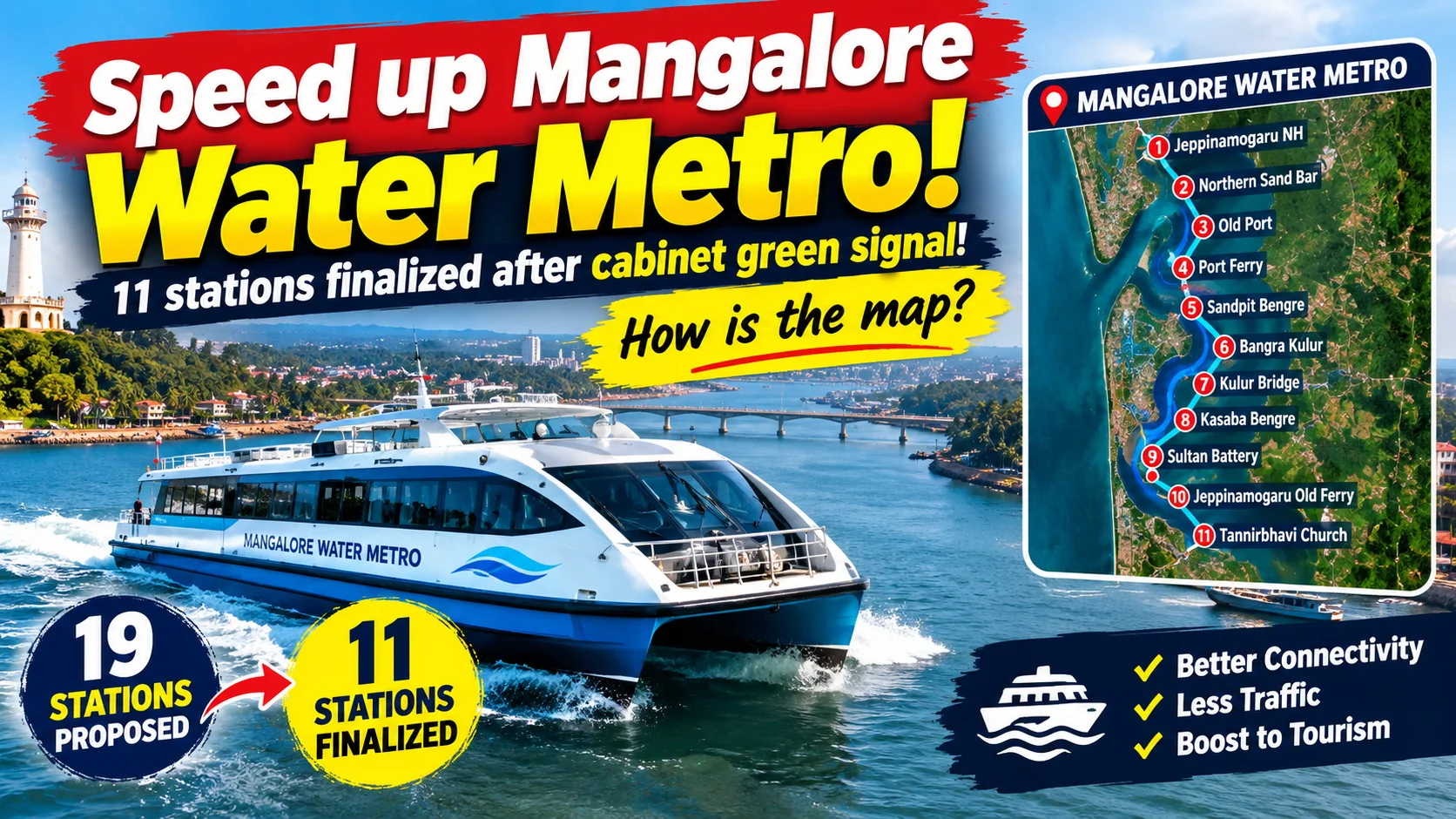
Mangalore’s much-awaited Water Metro project is now moving towards its next stage. The proposed project aims to use the city’s waterways for public transport, with 11 stations finalized out of the 19 proposed stations. The Cabinet’s green signal for the technical and financial feasibility study has added fresh momentum to the project.
Mangalore Water Metro Project Gains Momentum
The Mangalore Water Metro project has been proposed to create an additional public transport option by using the city’s waterways. The feasibility of using the Gurupura and Nethravathi waterways for the project is being examined as part of the planning process.
The project is expected to connect important areas around Mangalore through water-based transportation. The proposed network includes locations connected to the port, coastal areas and waterways.
11 Water Metro Stations Finalized
Out of the 19 stations proposed for the Mangalore Water Metro network, 11 stations have been finalized. These stations will form an important part of the next stage of technical planning and project development.

| No. | Station |
|---|---|
| 1 | Jeppinamogaru NH |
| 2 | Northern Sand Bar |
| 3 | Old Port |
| 4 | Port Ferry |
| 5 | Sandpit Bengre |
| 6 | Bangra Kulur |
| 7 | Kulur Bridge |
| 8 | Kasaba Bengre |
| 9 | Sultan Battery |
| 10 | Jeppinamogaru Old Ferry |
| 11 | Tannirbhavi Church |
Kulur Bridge Gets Special Attention
Kulur Bridge is one of the important locations in the proposed Water Metro network. Two separate station concepts, including a Ro-Ro and floating station model, are being considered for the area.
The proposed design is expected to take the nature of the waterway into account while planning the station infrastructure.
Connectivity to Port and Coastal Areas
The proposed Water Metro network is not limited to city transportation. Locations such as Old Port, Port Ferry, Sand Bar and Bengre are included in the proposed network.
Using waterways for public transportation could provide another travel option between selected areas. The project is also expected to create better water-based connectivity between different parts of Mangalore.
Cabinet Green Signal for Feasibility Study
The Cabinet has given in-principle approval for conducting a technical and financial feasibility study for the Water Metro project. The possibility of implementing the project through a PPP model is also being examined.
However, the approval at this stage should not be considered final approval for construction. Several important aspects still need to be examined before implementation.
DPR Will Decide Several Key Details
The Detailed Project Report, or DPR, will play an important role in determining the final structure of the project. Details such as the exact route, station design, land requirements, financial model and implementation plan will need to be finalized.
Other details, including travel time, service frequency, ticket fares and passenger capacity, have also not been finalized yet. These details are expected to become clearer during the next stages of planning.
A New Transport Option for Mangalore
The Water Metro project aims to use Mangalore’s waterways as an additional public transportation network. If implemented, it could provide water-based connectivity between selected areas instead of relying only on road transportation.
The proposed network also covers port and coastal areas. Its future impact on transportation, tourism and local connectivity will depend on the final route, services and implementation.
When Will Mangalore Water Metro Start?
The Mangalore Water Metro project is currently in the planning and feasibility stage. Although 11 stations have been finalized, an official service launch date has not yet been announced.
The technical and financial feasibility study, DPR, final route, station design, funding arrangements and implementation plan will have to progress before the project reaches the construction and service stage.
How Will the Mangalore Water Metro Map Look?
The proposed 11-station network indicates connectivity between several waterways, port areas and coastal locations in and around Mangalore. However, the complete and final route map will become clearer after the technical study and DPR are completed.
For now, the finalized station list provides an initial picture of how the Water Metro network could connect different parts of the city through waterways.
What Happens Next?
The finalization of 11 stations marks an important step in the development of the Mangalore Water Metro project. The upcoming feasibility study and DPR will determine several important aspects, including the final alignment, station design, financial structure and implementation process.
The project has not yet reached the stage of starting Water Metro services. More clarity about the timeline and final network is expected after the remaining planning and technical processes are completed.
Conclusion
The Mangalore Water Metro project has gained fresh momentum with 11 stations finalized from the proposed network. The Cabinet’s approval for the feasibility study takes the project into its next planning stage. The final route, construction timeline, fares and service details will depend on further technical studies and the DPR.
FAQs
1. How many stations have been finalized for Mangalore Water Metro?
Eleven stations have been finalized from the 19 stations proposed for the Water Metro network.
2. Which waterways are being considered for the project?
The project is being planned around the Gurupura and Nethravathi waterways.
3. When will Mangalore Water Metro services start?
An official service launch date has not yet been finalized. Further studies and the DPR need to be completed first.
4. What is special about Kulur Bridge?
Ro-Ro and floating station concepts are being considered for the Kulur Bridge location.