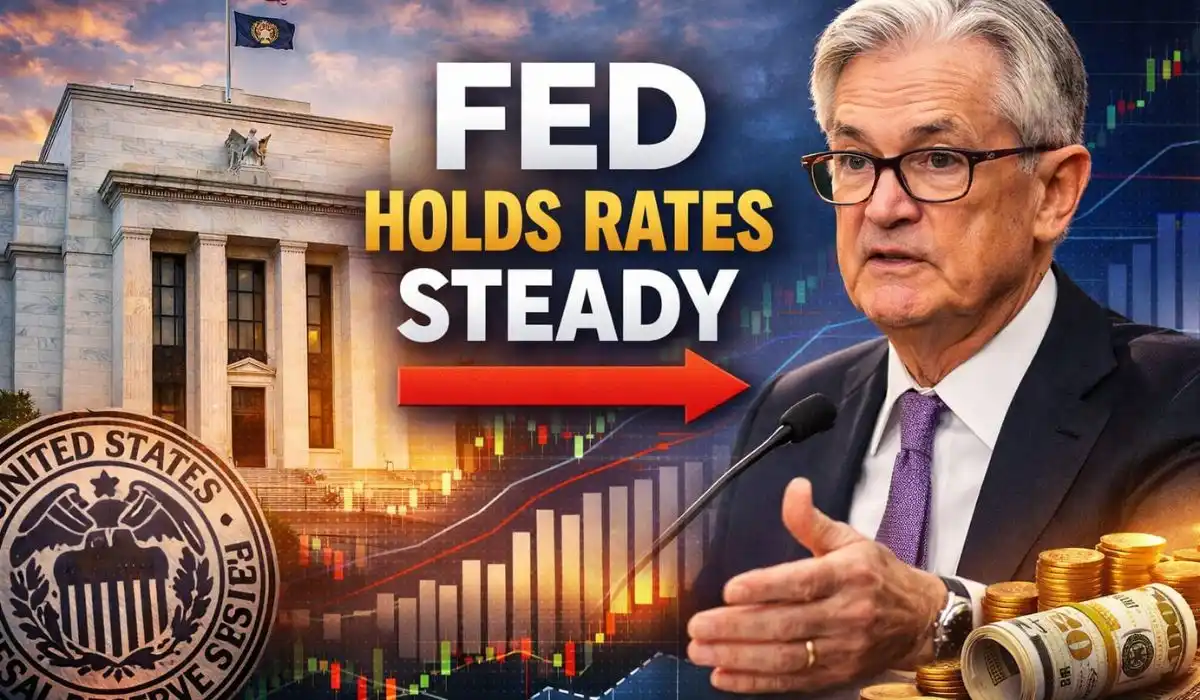
Washington, D.C. | January 28, 2026 : The U.S. Federal Reserve on Wednesday kept interest rates unchanged, marking a cautious start to 2026 as policymakers weigh persistent inflation risks against signs of slowing economic momentum. The decision, announced after the Federal Open Market Committee’s (FOMC) two-day meeting, confirms a pause in the easing cycle that began in late 2025.
Key Policy Decision
The FOMC voted unanimously to maintain the federal funds rate in the range of 3.50% to 3.75%, in line with market expectations. This was the Fed’s first policy decision of 2026 and follows three rate cuts delivered in 2025 as inflation cooled from multi-decade highs.
Fed officials emphasized that while inflation has moderated, it remains above the central bank’s 2% target, justifying a wait-and-watch approach before any further policy adjustments.

Economic Backdrop
Recent economic data presents a mixed picture:
- Inflation: Core inflation remains sticky, showing slower-than-expected progress toward the Fed’s target
- Labor market: Job growth has eased but remains resilient, with unemployment hovering near 4.4%
- Consumer spending: Still strong, supported by wage growth and household savings
This combination has complicated the Fed’s task, forcing policymakers to balance inflation control with the risk of overtightening the economy.
Powell Reaffirms Data-Driven Approach
Speaking at the post-meeting press conference, Federal Reserve Chair Jerome Powell reiterated that future decisions will depend strictly on incoming economic data.

“We are not on a preset path,” Powell said, stressing that the committee will remain flexible as inflation and labor market trends evolve.
The Fed also reaffirmed its commitment to independence, amid growing political scrutiny and public debate over the future direction of U.S. monetary policy.
Market Reaction
Financial markets reacted cautiously to the announcement:

- U.S. stocks were volatile, with major indices pulling back after recent record highs
- Bond yields showed limited movement, reflecting expectations that rates will remain stable in the near term
- Gold and other safe-haven assets attracted renewed interest as investors reassessed the pace of future rate cuts
Overall, the market response suggested that investors had largely priced in the Fed’s decision.
What Comes Next
Looking ahead, attention will shift to upcoming inflation reports, employment data, and economic projections. Many analysts expect the Fed to delay further rate cuts until mid-2026, unless inflation shows clearer and sustained improvement.
The next FOMC meeting is scheduled for March 2026, where updated economic forecasts and policymakers’ interest-rate projections could offer stronger signals about the remainder of the year.
Bottom Line
The Federal Reserve’s decision to hold rates steady underscores a measured and cautious policy stance at a time of economic uncertainty. While the easing cycle is not over, the message from policymakers is clear: future cuts will come only when inflation convincingly moves toward target levels.
For investors, businesses, and global markets, the Fed’s tone — not just its actions — will remain the key driver in 2026.