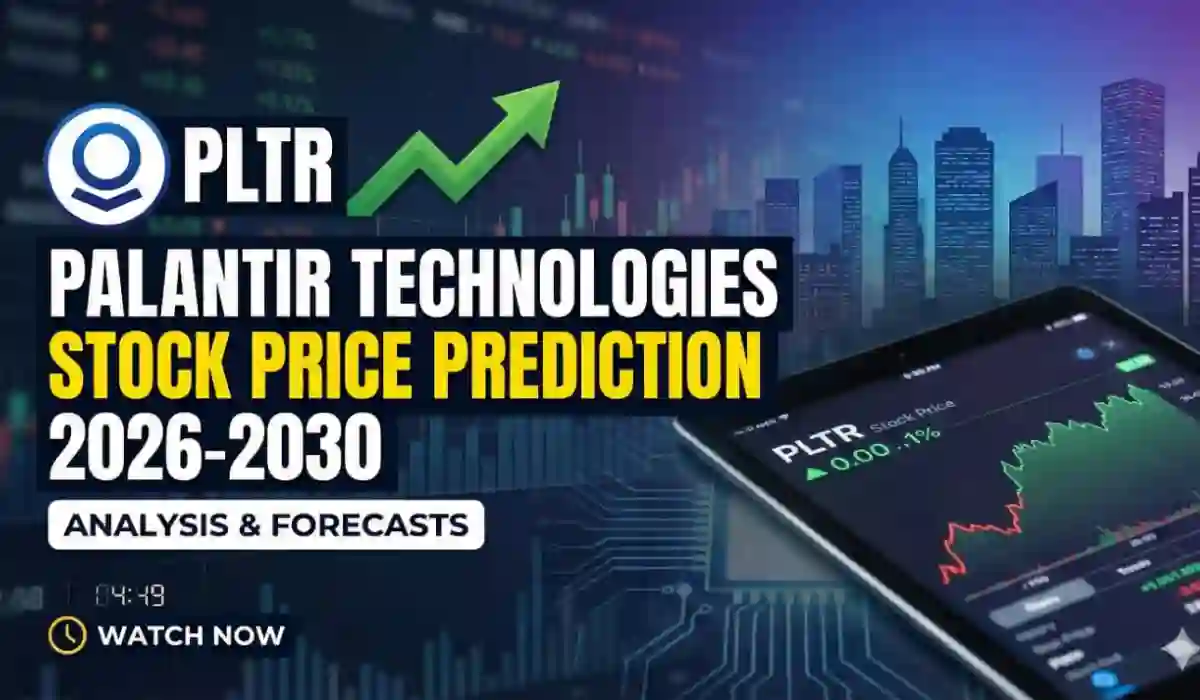
Palantir Technologies Stock Price Prediction From 2026 to 2030: Palantir Technologies Inc. (NASDAQ: PLTR) is a leading AI-powered data analytics and software company serving both government and commercial clients worldwide. Its core platforms — Gotham, Foundry, and AI Platform (AIP) — are used for large-scale data integration, analytics, and decision-making, making it a key player in the rapidly growing AI and data analytics market. With increasing global adoption of AI technologies and enterprise analytics solutions, Palantir is poised for long-term growth. In this article, we provide a detailed stock price prediction for Palantir from 2026 to 2030, along with its fundamental outlook, market opportunities, risks, and shareholding pattern.
📦 Key Highlights
- Palantir operates at the intersection of AI, data analytics, and enterprise software, serving defense, government, and commercial sectors.
- Analysts are cautiously optimistic, with growth potential tied to AI adoption and government contract wins.
- Revenue growth is expected to come from commercial expansion, recurring software contracts, and AI platform adoption.
- The stock remains volatile, but long-term investors may benefit from its technology leadership.
Palantir Fundamental Overview
Palantir’s long-term growth is driven by:
- Government & Defense Contracts: Recurring revenue from strategic contracts.
- Enterprise AI Adoption: Expansion of Foundry and AI platform in corporate clients.
- Recurring Software Revenue: Subscription and SaaS model provides stability.
- Innovation: Continued development of AI and analytics solutions strengthens competitive advantage.
- Global Expansion: Increasing presence in North America, Europe, and Asia.
The company has a strong technological moat, but high valuation and market volatility make it a moderately high-risk investment.

📊 Market Snapshot
- Opportunities: AI adoption, enterprise software growth, government contracts.
- Risks: High valuation, stock volatility, competitive pressure in AI and analytics.
- Analyst Outlook: Mixed ratings — Hold is the current consensus with upside potential in bullish scenarios.
- Investment Focus: Long-term investors targeting AI and data-driven growth sectors.
Palantir Stock Price Target 2026
In 2026, assuming steady growth in AI adoption and expansion of commercial contracts, Palantir’s stock may trade between $176 and $251. This reflects moderate optimism and continued execution in both government and enterprise segments.
Palantir Stock Price Target 2027
By 2027, as Palantir scales its AI platforms and secures more commercial contracts, the stock could reach $185 to $277, supported by recurring revenue and market expansion.
Palantir Stock Price Target 2028
In 2028, further adoption of AI and analytics solutions across multiple sectors, including healthcare, finance, and defense, may push the stock to $193 to $306.

Palantir Stock Price Target 2029
For 2029, long-term growth models suggest a range of $202 to $337, assuming consistent execution, increased enterprise penetration, and government contract renewals.
Palantir Stock Price Target 2030
By 2030, if Palantir maintains its growth trajectory, expands its AI solutions globally, and strengthens recurring revenue streams, the stock could trade between $211 and $371.
⚠️ Risk & Opportunity
Risks

- High valuation could limit near-term upside.
- Market volatility may cause price swings.
- Competition from other AI and analytics providers could impact growth.
Opportunities
- Expansion in enterprise AI adoption provides significant long-term revenue potential.
- Strategic government and defense contracts provide stable recurring income.
- Continued innovation in AI platforms could drive adoption and investor confidence.
Palantir Stock Price Prediction From 2026 to 2030
| Year | Minimum Target (USD) | Maximum Target (USD) |
|---|---|---|
| 2026 | $176 | $251 |
| 2027 | $185 | $277 |
| 2028 | $193 | $306 |
| 2029 | $202 | $337 |
| 2030 | $211 | $371 |
Palantir Shareholding & Structure
- Insiders & Founders: Significant holdings by Alex Karp, Peter Thiel, and other executives.
- Institutional Investors: Large global mutual funds, hedge funds, and pension funds hold major stakes.
- Retail Investors: Moderate participation in U.S. and international markets.
The shareholding structure reflects a balance between insider control and institutional participation, typical for high-growth tech stocks.
Disclaimer
This article is for educational and informational purposes only. It is not investment advice. Stock price predictions are based on forecasts, trend analysis, and assumptions which may not materialize. Always consult your financial advisor before making investment decisions.