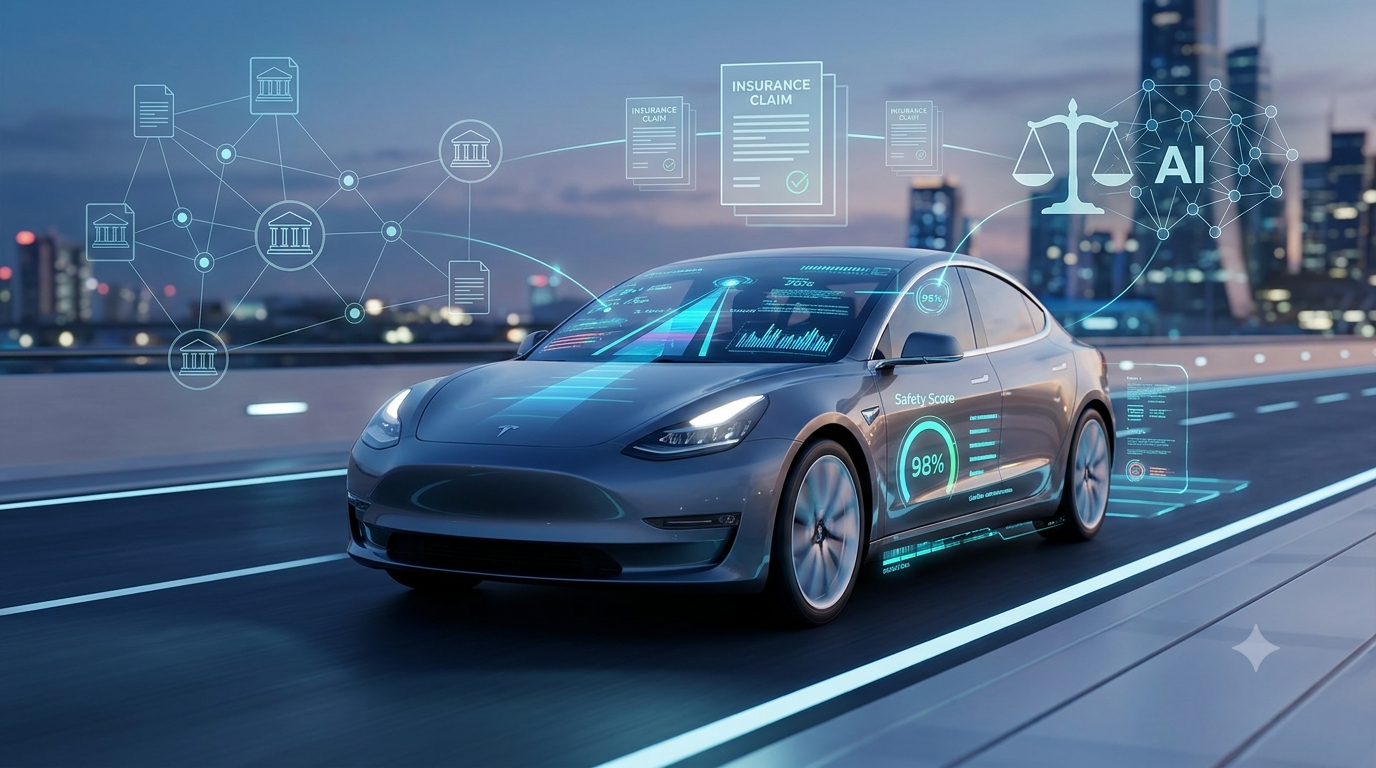
Tesla’s 2026 Full Self-Driving (FSD) updates use vision-based neural networks to dynamically influence auto insurance claim payouts and monthly rates. While high FSD usage can earn drivers up to 10% discounts under telemetry-based coverage, determining fault in Tesla Autopilot accident liability lawsuits remains complex. Knowing how to handle telemetry black box data is crucial if you need to file a Tesla accident insurance claim.
Introduction: The Changing Landscape of Autonomous Driving Claims
The automotive world has undergone a quiet revolution. Electric vehicle software updates are no longer just about fixing media console glitches or adding acceleration boosts; they now dictate vehicle safety, liability algorithms, and risk profile evaluations.
With the rollout of Tesla’s newest vision-only artificial intelligence driving software, millions of vehicles process millions of real-time road decisions per second. But as driver-assistance capabilities reach unprecedented levels, the line between driver error and software malfunction is becoming increasingly thin.
For policyholders, claims adjusters, and personal injury attorneys, this shift raises critical questions:
- Who pays when a semi-autonomous car misinterprets a lane marker or a traffic signal?
- How does your Tesla Safety Score insurance discount change when AI is driving?
- Can insurance companies deny your claim if you disengaged FSD seconds before an impact?
Whether you are shopping for cheap EV insurance rates or dealing with a complex collision claim, understanding how Tesla’s latest AI updates affect auto insurance claims in 2026 can save you thousands of dollars out of pocket.
1. AI Telemetry and the Evolution of the “Black Box” Claim
In traditional auto claims, determining fault relies on driver statements, eyewitness accounts, police reports, and physical damage assessment. However, modern electric vehicles function as rolling supercomputers.
When you file an EV insurance crash claim, your insurance company no longer relies solely on your story. Instead, insurers look at vehicle telemetry data.
How Telemetry Shapes 2026 Auto Claims
Tesla records detailed onboard telemetry parameters leading up to any impact:
| Data Metric | Impact on Insurance Claim |
| Steering Wheel Torque | Proves whether hands were detected on the wheel. |
| Brake/Accelerator Input | Shows if the driver overrode the AI system. |
| 5-Second Pre-Crash Snapshot | Records whether FSD was engaged leading up to impact. |
| Camera & Vision Logs | Identifies blind spots, road conditions, and third-party fault. |
Critical Takeaway for Policyholders: Under standard Tesla collision insurance terms, if Full Self-Driving (Supervised) was active within five seconds prior to an impact, the incident is logged as an AI-engaged collision. If an insurer proves you ignored system warnings to retake control, your claim could shift from a straightforward collision coverage payout to a contested driver negligence claim.
2. Dynamic Pricing: FSD Usage vs. Real-Time Safety Scores
The emergence of usage-based insurance (UBI) powered by real-time driving data has transformed how monthly auto premiums are calculated.
The 100-Point AI Advantage
Major carriers—alongside Tesla’s in-house insurance program—now reward drivers who delegate miles to verified autonomous systems. Because AI neural networks react faster than human drivers and do not experience fatigue or emotional distraction, driving with supervised FSD engaged earns drivers a maximum Safety Score of 100 for those specific miles.
Monthly Safety Score = (% of Miles with FSD Engaged × 100) + (% of Manual Miles × Manual Safety Score)
This formula creates a direct financial incentive: the more you let the updated AI drive, the lower your monthly auto insurance premium drops.
However, UBI carries a trade-off. If the AI system encounters a complex edge case—such as bad weather or unmapped construction—and disengages, manual driving errors made in those high-stress moments can quickly lower your overall Safety Score, causing your rates to rise the following month.
3. Product Liability vs. Driver Negligence: Who Is At Fault?
The most contentious legal battle in 2026 auto insurance centers on liability: When an AI-assisted vehicle crashes, is it a driver error or a product defect?
Level 2/3 Supervision Boundaries
Because Tesla’s driver-assistance technology remains legally classified as a supervised system requiring active driver monitoring, insurance companies generally hold the human driver liable for third-party property damage and bodily injury claims.
However, liability dynamics are shifting in three key areas:
- Phantom Braking Claims: Sudden braking on highways without hazards can cause rear-end collisions. Insurers are increasingly pursuing subrogation claims against EV manufacturers when telemetry logs confirm unprompted vehicle stopping.
- Software Glitches & Unmapped Hazards: If an over-the-air (OTA) update causes documented erratic behavior across multiple vehicles, class-action product liability insurance lawsuits come into play.
- Driver Inattention Penalties: If cabin-monitoring cameras register prolonged phone use or sleep during an FSD-engaged trip, insurance adjusters may issue a partial or full denial of comprehensive and collision coverage.
4. How Repair Costs and AI Hardware Impact Claims Payouts
Filing a claim for a damaged AI-enabled vehicle differs significantly from traditional auto body repair. Modern EVs are equipped with sensitive hardware, including exterior camera arrays, ultrasonic sensors, and onboard AI computers.
Why Tesla Collision Repairs Cost More
- Calibrating Cameras and Sensors: Even a minor fender bender requires precision re-alignment and software calibration for the vehicle’s vision suite. Failure to recalibrate can disable FSD features entirely.
- Specialized Certified Body Shops: Due to high-voltage safety protocols and proprietary aluminum casting, insurance adjusters must often approve higher labor rates at specialized repair facilities.
- Higher Total Loss Thresholds: Replacement costs for damaged AI computer hardware often lead insurance adjusters to write off vehicles as a total loss earlier than equivalent gas-powered cars.
If you are involved in an accident, ensure your claim includes coverage for Original Equipment Manufacturer (OEM) parts and proper sensor calibration to preserve your vehicle’s autonomous capabilities.
5. Step-by-Step: Filing an Insurance Claim After an AI-Related Crash
If you are involved in an accident while using driver-assist software, taking the right steps at the scene is essential to protect your claim.
1. Document the Scene and On-Screen Dash
Immediately take clear photos of the physical damage, surrounding road markings, weather conditions, and your vehicle’s center display screen showing any active alerts or error messages.
2. Request Your Vehicle Telemetry Logs
Under data privacy rules, you have the right to request your vehicle’s event data recorder (EDR) information and cloud telemetry following a crash. Do not wait; request these logs through your vehicle app right away before old data is overwritten.
3. Contact an Experienced Auto Accident Attorney
If another party alleges you were negligent while using autonomous features, consult a personal injury or car accident lawyer who understands autonomous vehicle telemetry and product liability laws before providing recorded statements to third-party adjusters.
Frequently Asked Questions (FAQ)
Does using Tesla Full Self-Driving lower my auto insurance rates?
Yes, in states where telemetry-based insurance is available, driving with FSD engaged boosts your monthly Safety Score, which can lead to lower premiums on participating policies.
Who is legally at fault if Tesla FSD causes an accident?
Because current consumer systems are classified as supervised driver-assist software, the human driver remains legally responsible for maintaining oversight and avoiding collisions.
Can an insurance company deny a claim if FSD was active during a crash?
Insurers generally cover claims under standard collision coverage. However, if evidence shows intentional misuse, disabled safety features, or reckless inattention, the carrier may challenge the claim.
Final Thoughts: Protecting Your Vehicle and Policy
As artificial intelligence continues to reshape vehicle control, insurance policies are adapting rapidly. To protect your finances and ensure full coverage:
- Review your policy annually to verify OEM parts coverage and gap insurance.
- Maintain high liability limits ($100k/$300k minimums) to protect against complex multi-vehicle claims.
- Monitor your monthly driving data to ensure your vehicle’s safety score reflects your actual driving habits.
By staying informed about software updates and insurance terms, you can safely navigate the future of autonomous driving while keeping your coverage secure.