New Delhi: When Finance Minister Nirmala Sitharaman presented the Union Budget 2026–27, expectations across India were sky-high. From middle-class taxpayers and MSMEs to big industry and investors, every section of society was hoping for bold reforms, strong relief measures, and transformative policy announcements.
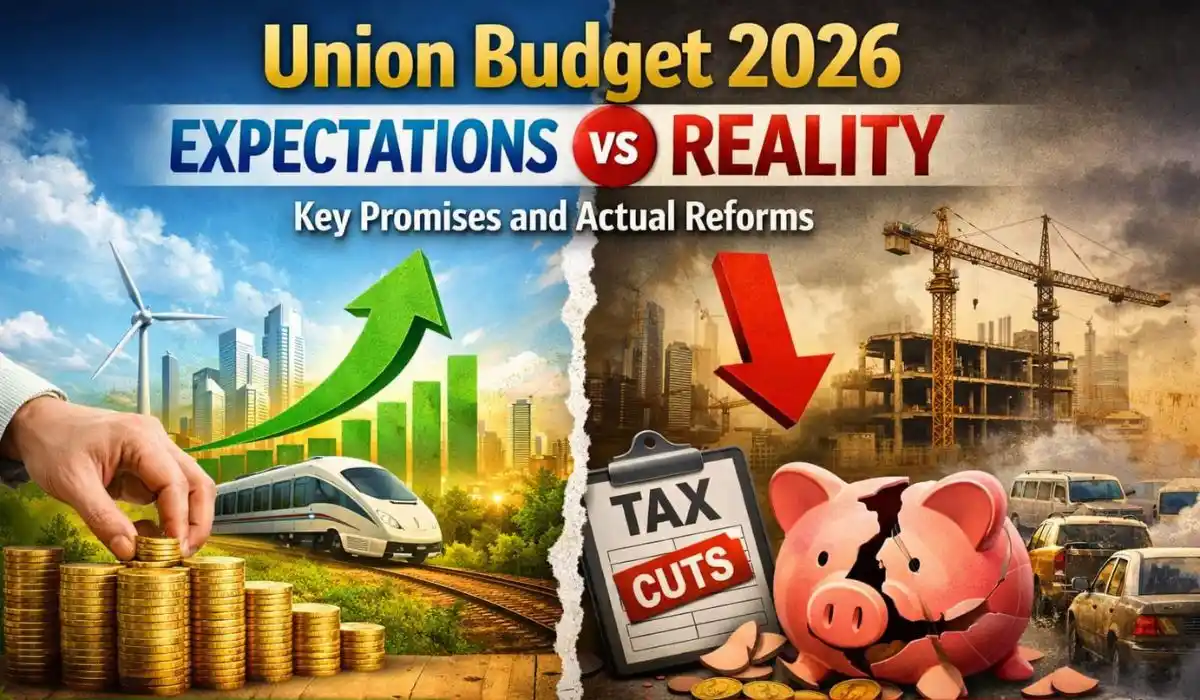
But once the Budget speech concluded, a clear picture emerged — a mix of fulfilled promises, partial delivery, and missed expectations. Here’s a comprehensive, fact-based analysis of Expectations vs Reality in Union Budget 2026, breaking down what India hoped for and what the government actually delivered.
Big Picture: Stability Over Populism
Expectation
The market and policy experts expected a fine balance between fiscal discipline and growth-oriented spending, with a focus on infrastructure and investment-led development.

Reality
The government stayed firmly on the path of macro-economic stability:
- Fiscal deficit target brought down to 4.3% of GDP
- Public capital expenditure raised to ₹12.2 lakh crore
- Clear focus on infrastructure-led growth instead of short-term populist spending
Verdict: Strategic and disciplined — growth over giveaways.
Income Tax Relief: Middle Class Disappointment
Expectation
The biggest public demand was income tax slab revision, higher deductions, and direct relief for salaried and middle-income families.

Reality
- No changes in income tax slabs
- No increase in standard deduction
- Focus remained on procedural reforms, including:
- Simplified compliance
- Extended revised return deadlines
- Digitisation of tax services
- Automation of certifications
Verdict: Structural reform over direct relief — a disappointment for taxpayers expecting slab changes.
Infrastructure: Promise Delivered
Expectation
A massive push for roads, railways, logistics, urban transport, and connectivity.
Reality
The Budget delivered strongly:

- Expansion of high-speed rail corridors
- Development of new national waterways
- Strengthening of multi-modal logistics
- Boost to freight corridors and port connectivity
Verdict: Infrastructure expectations fully met, reinforcing India’s long-term growth strategy.
Manufacturing & Strategic Sectors: Strong Policy Signal
Expectation
Support for Make in India, electronics, defence, semiconductors, and industrial manufacturing.
Reality
- Launch of India Semiconductor Mission 2.0
- Strategic push for:
- Electronics manufacturing
- Biopharma
- Chemicals
- Textiles
- Rare earth processing
- Defence manufacturing
Verdict: Visionary and future-focused — exceeded expectations in strategic sectors.
MSMEs & Employment: Structural Support
Expectation
Better credit access, job creation policies, and MSME reforms.
Reality
- ₹10,000 crore MSME Growth Fund
- Improved TReDS integration
- Digital compliance support
- Credit facilitation mechanisms
- Professional business support systems
Verdict: Long-term structural support rather than short-term subsidies.
Healthcare & Social Sector: Moderate Gains
Expectation
Stronger public healthcare funding, insurance reform, and affordability measures.
Reality
- Increased healthcare allocation
- Regional medical hubs
- Trauma care centres
- Training expansion for allied health professionals
- Duty exemptions on select life-saving drugs
Verdict: Positive direction, but insurance and affordability reforms remain limited.
Real Estate & Housing: Missed Opportunity
Expectation
Special incentives for affordable housing, tax benefits for homebuyers, and real estate sector support.
Reality
- No major housing-specific incentives
- Indirect benefit through infrastructure and economic stability
Verdict: Sector expectations largely unmet.
Expectations vs Reality Snapshot
| Sector | Public Expectation | Budget Reality | Outcome |
|---|---|---|---|
| Fiscal Policy | Growth + discipline | Fiscal consolidation + capex | Met |
| Income Tax | Slab relief | No slab changes | Not met |
| Infrastructure | Big push | Major expansion | Met |
| Manufacturing | Policy reforms | Strategic missions launched | Exceeded |
| MSMEs | Credit & support | Funds + reforms | Met |
| Healthcare | Major reforms | Partial improvement | Partially met |
| Real Estate | Housing incentives | No direct support | Not met |
Expert View: A Reformist Budget, Not a Populist One
Union Budget 2026 clearly signals a policy-first, stability-first approach. Instead of focusing on short-term electoral reliefs, the government chose:
- Capital investment over consumption
- Structural reform over populism
- Long-term growth over short-term applause
This makes the Budget investor-friendly, growth-oriented, and institutionally strong, but less emotionally satisfying for the middle class seeking immediate financial relief.
Final Verdict
Union Budget 2026 is a reformist budget, not a relief budget.
It delivers on:
- Infrastructure growth
- Manufacturing expansion
- MSME support
- Fiscal stability
- Strategic sector development
But falls short on:
- Direct tax relief
- Middle-class financial support
- Housing incentives
- Cost-of-living relief
In simple terms:
The government chose nation-building over headline-grabbing populism — strengthening India’s economic foundation, but leaving many individual taxpayers waiting for direct benefits.